Who Is Actually Responsible for Packaging Compliance Under the PPWR? The Brand Owner, the Filler, or the Packaging Supplier?
Need to understand how responsibility fits into the wider EU packaging framework? This article connects to our EU EPR and PPWR compliance guide, which explains producer responsibility, packaging registration, reporting, recyclability, fees, data management and conformity obligations across Europe.
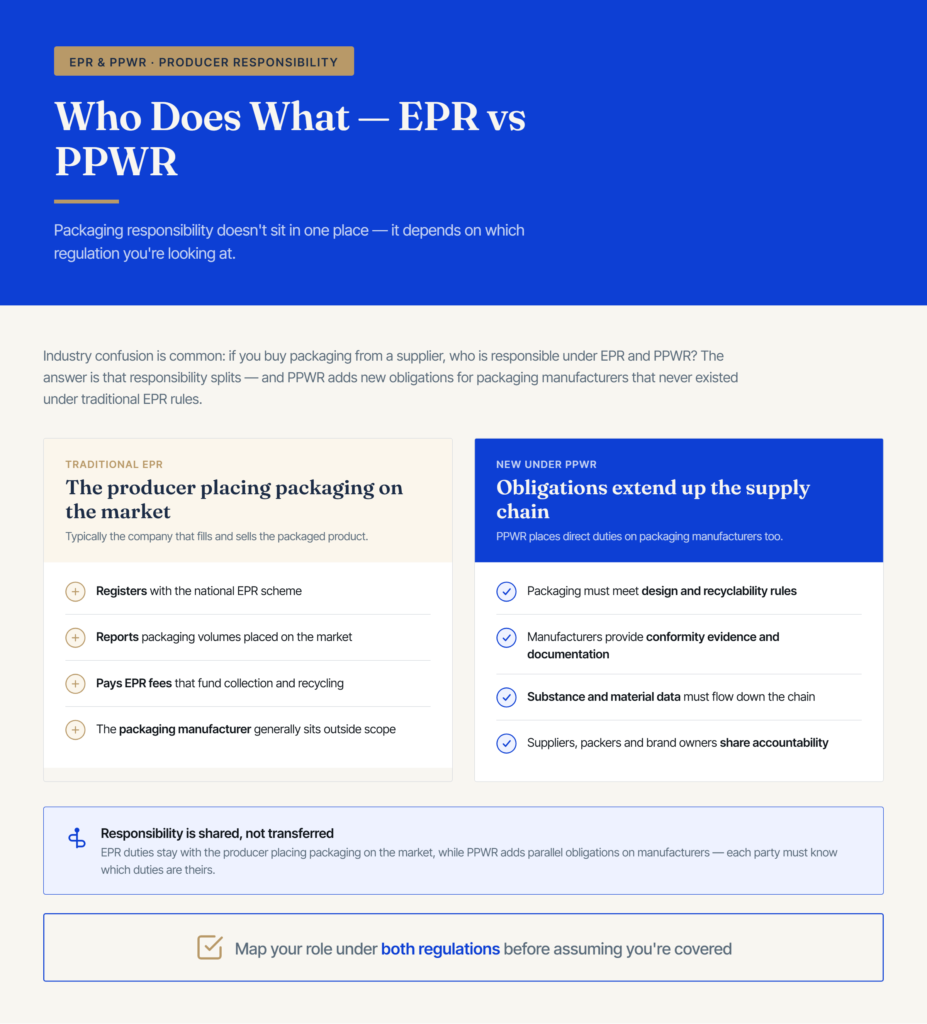
There is genuine confusion across the industry about who carries the legal responsibility for packaging compliance in Europe. The question we hear most often is some version of: "We buy our packaging from a supplier and fill it ourselves – so who is responsible under the PPWR and EPR? Us, or the company that physically makes the packaging?"
The Packaging and Packaging Waste Regulation – Regulation (EU) 2025/40, applicable from 12 August 2026 (Article 71) – answers this through two distinct legal roles: the manufacturer and the producer. They sound interchangeable. They are not. And neither of them means what most people intuitively assume.
This article explains both roles strictly on the basis of the regulation text and the European Commission's guidance document of 5 June 2026 (C(2026) 3702 final), and then works through real-life scenarios. One warning up front: the answer is not always "the brand owner." For certain packaging categories, the new rules place responsibility on parties that have never carried it before.
1. The "Manufacturer" – Who Owns Conformity?
What the regulation says
The manufacturer is defined in Article 3(1), point (13):
"'manufacturer' means any natural or legal person that manufactures packaging or a packaged product; however: (a) subject to point (b), where a natural or legal person has packaging or a packaged product designed or manufactured under its own name or trademark, regardless of whether any other trademark is visible on the packaging or on the packaged product, 'manufacturer' means that natural or legal person;"
The starting point is the physical maker – but point (a) overrides it: whoever has the packaging or packaged product designed or manufactured under its own name or trademark becomes the manufacturer, even if another trademark is also visible.
The Commission's June 2026 guidance adds three clarifications that matter in practice:
- There is only one manufacturer per supply chain. The Commission states that the wording of the definition indicates there is always only one manufacturer in a supply chain within the meaning of the PPWR. Responsibility does not stack or split.
- For sales and grouped packaging, the manufacturer is normally the filler. In the Commission's words, the manufacturer is normally the operator that applies the final processing steps – cutting, filling, sealing – "who is often also the product brand owner." Where packaging carries a trademark, the owner of that trademark can be assumed to be the manufacturer.
- For transport, service and primary production packaging, the default flips. Here the manufacturer is normally the company that makes the transport or service packaging – i.e. the packaging supplier – unless that packaging is clearly branded by its user, in which case the user is the manufacturer.
And if the packaging carries no brand at all? The guidance gives a concrete test: the manufacturer is then either the supplier or the company ordering the packaging, and the decisive criterion is who places the order and decides on the design specifications.
What the manufacturer must do
Under Article 15(1), manufacturers may only place on the market packaging that conforms with the requirements laid down in or pursuant to Articles 5 to 12. Before placing packaging on the market, the manufacturer must carry out the conformity assessment procedure of Article 38 – or have it carried out on its behalf – and draw up the technical documentation set out in Annex VII (the "Module A – internal production control" procedure) (Article 15(2)). Where conformity is demonstrated, the manufacturer draws up the EU Declaration of Conformity in accordance with Article 39, following the model in Annex VIII.
The technical documentation and the Declaration of Conformity must be kept for 5 years for single-use packaging and 10 years for reusable packaging, counted from the date the packaging was placed on the market (Article 15(3)).
The Commission's guidance leaves no ambiguity about where the buck stops: the manufacturer is the sole economic operator bearing legal responsibility for the packaging's compliance with the sustainability and labelling requirements, regardless of who actually drafted the Declaration of Conformity or parts of it.
Be careful with the dates
Not every requirement in Articles 5 to 12 applies from 12 August 2026. The Commission's FAQ is explicit that the obligations of manufacturers must be read together with the substantive obligations, several of which start later:
- From 12 August 2026: the general obligation to minimise substances of concern (Article 5(1)); the 100 mg/kg combined limit for lead, cadmium, mercury and hexavalent chromium (Article 5(4)); and the PFAS limits for food-contact packaging (Article 5(5)).
- From 1 January 2030 – or 24 months after the design-for-recycling delegated acts enter into force, whichever is later: the requirement that packaging be recyclable within performance grade A, B or C (Article 6(3)). The delegated acts are due by 1 January 2028, so this date can move. From 1 January 2038, only grades A or B may be placed on the market – that date is fixed in the text.
- From 1 January 2030 – or 3 years after the implementing act under Article 7(8) enters into force, whichever is later: the minimum recycled-content percentages for plastic packaging (Article 7(1)).
- From 1 January 2030: the packaging minimisation requirements (Article 10).
- From 1 January 2030 – or 3 years after the methodology implementing acts enter into force, whichever is later: the 50% maximum empty-space ratio, which applies to economic operators who fill grouped, transport or e-commerce packaging (Article 24(1)), not to manufacturers as such.
- Labelling: the Commission must adopt the harmonised label specifications by 12 August 2026 (Article 12(6)); the sorting-label obligation itself applies from 12 August 2028 or 24 months after that implementing act enters into force, whichever is later (Article 12(1)).
For everything without its own later date, the general rule applies: the conformity assessment must be carried out by 12 August 2026.
2. The "Producer" – Who Owns EPR?
What the regulation says
The producer is defined in Article 3(1), point (15) – not in the EPR articles themselves. The definition has five limbs, built around a different trigger than people expect: not "who places on the market," but who makes packaging or packaged products available for the first time on the territory of a Member State. In compressed form:
- (a) an operator established in a Member State that makes transport, service or primary production packaging available for the first time, from within that Member State's territory and on that same territory – note: this concerns the empty packaging;
- (b) an operator established in a Member State that makes packaged products – sales and grouped packaging – available for the first time, from within and on that same territory;
- (c) and (d) an operator – established in a Member State or a third country – that makes packaging or packaged products available for the first time on the territory of another Member State, directly to end users (the distance-selling limbs);
- (e) an operator established in a Member State that unpacks packaged products without being an end user, unless someone else already qualifies under (a)–(d).
The producer must register in the national register of producers in each Member State where it first makes packaging available (Article 44(2)) and carries extended producer responsibility under Article 45: financing and reporting for the packaging it makes available for the first time on that Member State's territory or unpacks without being an end user. The financial contributions are modulated according to the recyclability performance grades of Article 6 (Article 6(8)).
Recital 122 captures the design intent: one producer per packaging unit, identified in the Member State where the packaging is expected to become waste. The Commission's guidance adds the practical anchor: the relevant Member State will usually be where the packaging is filled, and for online sales, offering a product to an end user counts as making it available in the end user's Member State.
The point most companies miss
Read limb (a) again. For transport, service and primary production packaging, the producer is identified for the empty packaging – so EPR normally sits with whoever first makes that empty packaging available in the Member State, typically the packaging supplier or its distributor, not the company that later fills it. Recital 122 explains why: to spare small businesses that fill such packaging at the point of sale, the producer should be the manufacturer, distributor or importer that makes the packaging available for the first time from within the Member State's territory.
The Commission's guidance adds one refinement: if the transport packaging bears a name or trademark, the producer will normally be the filler; if it is not uniquely identifiable, the actual maker of the packaging will normally be the producer.
This is a genuine departure from how many national EPR schemes have historically worked, where the filler reported its transport packaging. Suppliers of pallets, crates, stretch wrap and service packaging should not assume that EPR remains someone else's problem after 12 August 2026.
3. Real-Life Scenarios – Answered Strictly from the Text
The brand has the packaged product manufactured under its own trademark, so it is the manufacturer under Article 3(1)(13)(a) – it owns the conformity assessment, the Annex VII technical documentation and the Article 39 Declaration of Conformity. It is also the producer under Article 3(1)(15)(b), because it makes the packaged product available for the first time on Dutch territory, so it registers and pays EPR fees in the Netherlands (Articles 44–45). The converter is neither – but it must supply, under Article 16(1), all the information and documentation necessary for the manufacturer to demonstrate conformity.
Still the brand owner. Article 3(1)(13)(a) attaches manufacturer status to the party that has the packaged product manufactured under its own name or trademark, "regardless of whether any other trademark is visible on the packaging." The contract filler's physical role does not displace the trademark override, and the Commission confirms there is only one manufacturer per supply chain.
Two different answers, and this is where intuition fails. Manufacturer: for transport packaging without a brand, the Commission's guidance points to the company that makes the packaging – or, where unclear, to whoever placed the order and decided the design specifications. Producer: under Article 3(1)(15)(a), the producer of transport packaging is identified for the empty packaging – normally the supplier or distributor that first makes the wrap and pallets available in that Member State, not the logistics operator that uses them. Had the wrap carried the operator's own branding, both answers could shift toward the operator.
The distributor is established in a Member State and makes the packaged products available for the first time on Dutch territory – it is the producer under Article 3(1)(15)(b), with registration, fee and reporting obligations in the Netherlands. And if it places that packaging on the market under its own name or trademark, or modifies it in a way that could affect compliance, Article 21 treats it as the manufacturer too, with the full set of Article 15 obligations.
Under Article 3(1)(15)(d), an operator established in one Member State that makes packaged products available for the first time on the territory of another Member State directly to end users is the producer there. The German seller therefore carries EPR obligations in France. Because it is established outside the Member State of the end user, it must appoint an authorised representative for extended producer responsibility in France (Article 3(1)(20); Recital 123), and Member States may provide for that representative to meet the registration obligations on the producer's behalf under a written mandate (Article 44(3)).
The unpacking limb applies: an operator established in a Member State that unpacks packaged products without being an end user is the producer for that packaging, unless another party already qualifies under limbs (a)–(d) (Article 3(1)(15)(e)). Unpacking is not a compliance-free activity.
Here the override reverses. Under Article 3(1)(13)(b), where the own-brand company is a micro-enterprise (per Recommendation 2003/361/EC as applicable on 11 February 2025) and the packaging supplier is located in the same Member State, the supplier is the manufacturer – and, per the Commission's guidance, this applies regardless of whether the supplier is itself a micro-enterprise.
The Commission's guidance is blunt: the PPWR does not foresee a transitional period for the exhaustion of stocks. Food-contact packaging placed on the market after 12 August 2026 must meet the Article 5(5) PFAS limits; packaging placed on the market before that date may remain on the market and need not be withdrawn. And note when placing on the market happens for filled goods: sales and grouped food-contact packaging are, in general, placed on the market when they are filled.
4. So Where Does the Packaging Supplier Sit?
For sales and grouped packaging – the typical "we buy it, we fill it, we brand it" chain – the supplier is normally neither the manufacturer nor the producer. Its legal role is defined by Article 16: providing the manufacturer with all the information and documentation needed to demonstrate conformity, including what feeds the Annex VII technical documentation, in a language the manufacturer can easily understand, in paper or electronic form.
But the supplier is not outside the regulation across the board:
- For transport, service and primary production packaging, the supplier is normally the manufacturer (unless the packaging is branded by its user) and normally the producer for EPR under Article 3(1)(15)(a).
- A supplier that places packaging on the market under its own name or trademark is the manufacturer for that packaging.
- Under the micro-enterprise rule, the supplier inherits manufacturer status from a micro-enterprise brand owner in the same Member State.
The honest summary: for branded consumer packaging, the brand owner owns both conformity and EPR, and the supplier is its essential evidence partner – not its compliance shield. For unbranded transport and service packaging, the centre of gravity moves up the chain to the supplier itself.
5. Final Message for the Industry
The PPWR's real test is operational, not conceptual. By 12 August 2026, for every requirement that applies from that date, the manufacturer must have completed the Article 38 conformity assessment, assembled the Annex VII technical documentation, and drawn up the Article 39 Declaration of Conformity – built on verified supplier data obtained under Article 16. Producers must be ready to register and report in each Member State where they first make packaging available. And every company touching transport or service packaging should re-run the "who is the producer?" analysis under the new definition, because for those categories the answer has changed.
The requirements with later start dates – recyclability grades, recycled content, minimisation, empty-space limits, harmonised labels – should be tracked, not asserted: several of them hinge on delegated and implementing acts still to enter into force.
Disclaimer
This article is based on Regulation (EU) 2025/40 (PPWR), the European Commission's guidance document of 5 June 2026 (C(2026) 3702 final), and the Commission's published questions and answers on the PPWR. Interpretations may evolve as the Commission and national authorities adopt implementing and delegated acts or publish further clarifications. The content does not take account of product-specific characteristics, packaging technical specifications, or Member State-level recycling infrastructure, all of which may affect final obligations. It is provided for general information only and does not constitute legal advice. Businesses should verify requirements with national authorities, their producer responsibility organisations, or their legal and compliance advisors before making compliance decisions.