PPWR Article 5 is one of the most important substance-related requirements under the EU Packaging and Packaging Waste Regulation. It directly affects how companies assess PFAS, heavy metals, substances of concern, supplier evidence, testing reports and PPWR technical documentation for packaging placed on the EU market.
The Packaging and Packaging Waste Regulation, commonly known as the PPWR, is changing the way companies design, source, document and place packaging on the EU market. While many businesses are already discussing recyclability, recycled content, labelling, packaging minimisation and reuse targets, PPWR Article 5 deserves special attention from packaging, regulatory, quality, procurement and sustainability teams.
Article 5 deals with requirements for substances in packaging. In practical terms, it requires companies to control the presence and concentration of substances of concern in packaging materials and packaging components. It also continues the long-standing restriction on certain heavy metals and introduces specific PFAS limits for food-contact packaging from 12 August 2026.
For businesses preparing for the 2026 PPWR application date, PPWR Article 5 should be treated as an early compliance priority because supplier evidence, testing reports and technical documentation can take time to collect.
Table of Contents
- What Is PPWR Article 5?
- Why PPWR Article 5 Matters for Businesses
- Key PPWR Article 5 Requirements at a Glance
- Heavy Metals Under PPWR Article 5
- PFAS Limits for Food-Contact Packaging
- What the Recent European Commission FAQ Clarifies
- Which Packaging Components May Create Article 5 Risk?
- Supplier Declarations: Are They Enough?
- Article 5 and PPWR Technical Documentation
- How RegSurance and PaxHub Can Support Businesses
- Frequently Asked Questions on PPWR Article 5
This makes Article 5 a business-critical compliance requirement, not only a legal clause. It affects supplier data collection, packaging specifications, food-contact materials, technical documentation, declarations of conformity, testing strategy and import controls. For companies placing packaged goods on the EU market, Article 5 should be addressed early because the evidence needed for compliance often sits across suppliers, converters, laboratories, procurement records, technical files and internal packaging databases.
1. What Is PPWR Article 5?
PPWR Article 5 is titled “Requirements for substances in packaging.” Its main objective is to ensure that packaging placed on the EU market is manufactured in a way that minimises the presence and concentration of substances of concern.
The article applies to packaging materials and packaging components. This point is important because compliance is not limited to the visible outer packaging or the main pack body. Depending on the packaging format, PPWR Article 5 may require attention to coatings, inks, adhesives, varnishes, liners, labels, closures, sealants, barrier layers, surface treatments and other components that form part of the packaging system.
In simple terms, Article 5 asks companies to answer a practical question: can you demonstrate that your packaging does not contain restricted substances above the relevant thresholds, and can you prove this with suitable documentation?
For many businesses, the real challenge will not be understanding the legal wording. The real challenge will be gathering reliable evidence from suppliers, identifying high-risk packaging components, deciding where testing is necessary and creating technical documentation that can withstand regulatory scrutiny.
2. Why PPWR Article 5 Matters for Businesses
PPWR Article 5 matters because packaging compliance under the PPWR is moving from broad environmental commitments to evidence-based conformity. Businesses will need to show that packaging meets specific legal requirements before it is placed on the EU market.
This has a direct operational impact. Packaging teams will need accurate component-level data. Procurement teams will need supplier declarations and change-control commitments. Regulatory teams will need to assess applicable legal requirements. Quality teams may need to coordinate testing and verification. Importers and distributors will need to ensure that the required documentation exists before placing or making products available on the market.
PPWR Article 5 is especially relevant for businesses in food, beverages, FMCG, cosmetics, pharma, retail, e-commerce, packaging manufacturing, private label, food service and consumer goods. It is also highly relevant for companies importing packaged products into the EU, because imported packaging must meet the same requirements as packaging manufactured within the EU.
3. Key PPWR Article 5 Requirements at a Glance
PPWR Article 5 creates three major compliance areas.
First, packaging must be manufactured so that the presence and concentration of substances of concern are minimised. This is a broad requirement and should be considered across the packaging material and all relevant components.
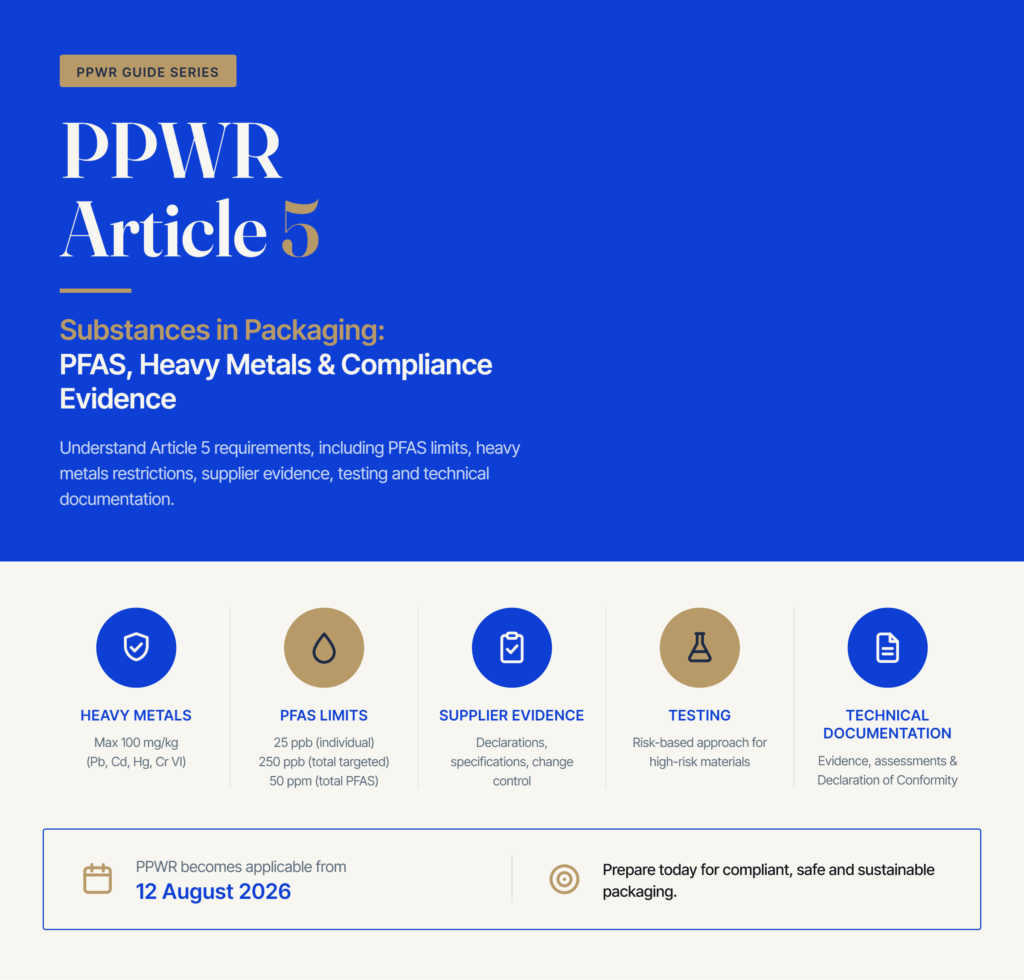
Second, the combined concentration of lead, cadmium, mercury and hexavalent chromium in packaging or packaging components must not exceed 100 mg/kg.
Third, from 12 August 2026, food-contact packaging must not be placed on the EU market if PFAS are present at or above the relevant PPWR thresholds.
These requirements link directly to technical documentation. Businesses must be able to demonstrate compliance, and this means keeping supplier evidence, declarations, test reports and internal assessment records in an organised and retrievable way.
4. Heavy Metals Under PPWR Article 5
One of the clearest requirements under PPWR Article 5 is the heavy metals restriction. Packaging must not exceed 100 mg/kg as the total combined concentration of the following four heavy metals: lead, cadmium, mercury and hexavalent chromium, also known as chromium VI.
This requirement is not completely new, as heavy metals have been controlled under EU packaging rules for many years. However, under the PPWR, companies should treat this requirement as part of the wider conformity assessment and technical documentation process.
Under PPWR Article 5, heavy metals evidence should be kept at packaging component level wherever possible, especially for inks, coatings, pigments, recycled materials and imported packaging.
The practical question for businesses is not only whether the packaging complies. The question is whether they can prove it. Evidence may include supplier declarations, material specifications, historical test reports, third-party laboratory reports, internal compliance assessments and change-control records.
Businesses should also avoid assuming that a general supplier statement is always sufficient. For high-risk materials, recycled inputs, unknown suppliers, imported packaging, printed components, coloured materials or complex multilayer structures, additional verification may be required.
5. PFAS Limits for Food-Contact Packaging
The PFAS requirement is one of the most important PPWR Article 5 developments. From 12 August 2026, food-contact packaging cannot be placed on the EU market if it contains PFAS at or above the following thresholds:
25 ppb for any individual PFAS measured through targeted PFAS analysis, with polymeric PFAS excluded from quantification.
250 ppb for the sum of targeted PFAS, where applicable with prior degradation of precursors, with polymeric PFAS excluded from quantification.
50 ppm for total PFAS, including polymeric PFAS.
For food-contact packaging, PPWR Article 5 creates a direct link between PFAS control, supplier declarations, laboratory testing and market access after 12 August 2026.
This requirement is highly relevant for food-contact packaging such as paper, board, fibre-based packaging, grease-resistant packaging, fast-food packaging, bakery packaging, food wrappers, trays, bowls, liners, coatings and barrier-treated materials. It may also be relevant for multilayer packaging and packaging where fluorinated substances, grease barriers or water-resistant treatments have historically been used.
The key point is that businesses should not simply ask suppliers whether packaging is “PFAS-free” and consider the matter closed. A robust PPWR Article 5 approach requires understanding the packaging material, the component structure, the intended use, the food-contact status, the supplier evidence and the testing basis behind any PFAS claim.
6. What the Recent European Commission FAQ Clarifies
The European Commission’s recent PPWR FAQ and guidance provide important practical clarification for businesses preparing for Article 5.
One of the most important clarifications is that there is no stock-exhaustion period for non-compliant PFAS food-contact packaging first placed on the market after 12 August 2026. This means food-contact packaging containing PFAS at or above the PPWR Article 5 thresholds cannot continue to be placed on the EU market after that date simply because it was produced earlier.
Packaging that was already placed on the market before 12 August 2026 may remain on the market and does not need to be withdrawn only because of the new PFAS restriction. However, food-contact packaging placed on the EU market after 12 August 2026 must comply with the PFAS limits.
The FAQ also clarifies that sales packaging and grouped food-contact packaging are generally considered placed on the market when they are filled, because final processing steps such as sealing may influence packaging compliance. Transport packaging and service packaging may be placed on the market empty, depending on the specific scenario.
This is very important for manufacturers, fillers, importers and private-label businesses. Companies should not only look at when empty packaging was produced. They should assess when the packaging, whether empty or filled, is first made available on the EU market under the PPWR placing-on-the-market concept.
The recent FAQ also confirms that there is currently no fully harmonised EU testing methodology for PFAS in food-contact packaging. This means companies need a defensible, risk-based testing approach. In practice, businesses may need to combine supplier declarations, material knowledge, screening tests and targeted analysis depending on the packaging risk profile.
7. Which Packaging Components May Create Article 5 Risk?
Article 5 risk is not limited to one type of packaging. Different materials and components may create different risk profiles.
In food-contact packaging, higher-risk areas may include grease-resistant paper, barrier coatings, water-resistant coatings, moulded fibre, fast-food wraps, bakery bags, food trays, paper cups, liners and coated boards. In plastic packaging, risk may arise from additives, multilayer structures, pigments, recycled content, adhesives or processing aids. In printed packaging, inks, varnishes and coatings should be assessed. In flexible packaging, laminates, adhesives, sealants and barrier layers may need closer attention.
Recycled-content packaging also deserves careful review. Recycled materials can support circularity goals, but they may also introduce legacy contamination risks if the input stream is not well controlled. This does not mean recycled materials should be avoided. It means they should be supported by proper supplier evidence, specifications, testing where relevant and documented risk assessment.
PPWR Article 5 should therefore be assessed at packaging component level, not only at finished packaging level. This is particularly important for companies with complex packaging portfolios, multiple suppliers and large SKU ranges.
Who Is Responsible for Article 5 Compliance?
One common misunderstanding is that the packaging converter or supplier is always the legally responsible party. Under the PPWR, the position can be more complex.
For sales packaging and grouped packaging, the manufacturer is often the filler or brand owner, especially where that company places the packaged product on the market under its own name or brand. This means the brand owner or filler may need to ensure that the packaging complies with PPWR Article 5, even if the physical packaging was produced by an external converter.
Suppliers still have a critical role. They must provide the information and documentation needed to demonstrate conformity. However, supplier documents do not automatically transfer responsibility away from the business placing the packaging on the market.
Importers must also be careful. They need to ensure that the relevant conformity assessment and technical documentation are available. Distributors must act with due care and should not make packaging available on the market where they have reason to believe it is non-compliant.
If an importer or distributor places packaging on the market under its own name or trademark, or modifies packaging in a way that may affect compliance, it may take on manufacturer-level obligations.
8. Supplier Declarations: Are They Enough?
Supplier declarations are important, but they are not always enough on their own.
For lower-risk packaging, a well-prepared supplier declaration supported by specifications, material information and change-control commitments may be sufficient as part of the evidence file. However, for higher-risk packaging, food-contact packaging, PFAS-sensitive materials, recycled inputs, unknown supply chains or weak supplier documentation, testing may be required.
A strong supplier declaration should not be a vague one-line statement. It should identify the supplier, the packaging item, the component, the material, the intended use, the food-contact status, the relevant PPWR Article 5 requirement, the basis of the declaration and the supporting documents.
It should also include a change notification commitment. This is important because packaging compliance can be affected by changes in raw materials, coatings, inks, adhesives, production sites, suppliers, processing aids or recycled input streams.
For PPWR Article 5, supplier declarations should be linked to actual packaging components and supported by evidence wherever possible. A declaration that simply says “compliant with all applicable laws” may not be strong enough for a technical file.
Article 5 evidence in practice.
See how RegSurance structured supplier evidence, substance-compliance logic and Annex VII technical documentation for two packaging formats under Regulation (EU) 2025/40.
Read the case study →When Is Testing Needed?
The PPWR does not say that every packaging item must be tested in every case. However, businesses must be able to demonstrate compliance. Testing becomes important where risk is material or where supplier evidence is insufficient.
Testing should be considered for food-contact packaging with potential PFAS risk, grease-resistant materials, coated paper and board, barrier-treated materials, recycled inputs, imported packaging, high-volume packaging, new suppliers, changed formulations, unclear declarations or packaging components with unknown composition.
For heavy metals, testing may be relevant where pigments, inks, coatings, recycled materials, imported components or historical data indicate potential risk. A laboratory report should ideally identify the exact component tested, the test method, the detection limits, the individual results and the conclusion against the Article 5 threshold.
For PFAS, businesses should work with competent laboratories and define the testing scope carefully. Testing the wrong component or relying on a generic finished-pack result may not be sufficient where the risk is concentrated in a coating, barrier layer, liner or treatment.
A practical testing strategy under PPWR Article 5 should be risk-based. It should focus first on high-risk food-contact packaging, coated or treated fibre-based materials, packaging with unclear supplier evidence, and packaging that is strategically important for the business.
9. Article 5 and PPWR Technical Documentation
Article 5 should be integrated into the PPWR technical documentation process. The PPWR requires companies to demonstrate conformity with relevant packaging requirements, and Article 5 evidence should form part of that file.
A practical PPWR Article 5 technical file should include packaging identification, intended use, food-contact status, bill of materials, component list, material specifications, supplier declarations, heavy metals evidence, PFAS evidence where relevant, test reports, risk assessment, legal requirement mapping and change-control records.
This means PPWR Article 5 evidence should not remain scattered across emails, supplier PDFs and internal spreadsheets.
The file should also link to the EU Declaration of Conformity where applicable. The Declaration of Conformity should not be treated as a standalone document created at the end. It should be supported by real evidence and updated when packaging design, material composition, supplier setup or legal requirements change.
Practical PPWR Article 5 Compliance Checklist
Businesses preparing for PPWR Article 5 should take a structured approach.
Start by mapping all packaging formats placed on the EU market. For each packaging format, create a component-level bill of materials. Identify whether the packaging is food-contact or non-food-contact. Determine who is the legal manufacturer under the PPWR. Identify importers, distributors and suppliers involved in the chain.
Next, request supplier declarations and supporting documents for each relevant packaging component. Ask suppliers specifically about heavy metals, PFAS where relevant, substances of concern, food-contact status, material composition, coatings, additives and change-control procedures.
Then risk-rank the packaging portfolio. Higher-risk packaging should be prioritised for deeper review. This may include food-contact packaging, coated paper, grease-resistant packaging, barrier-treated materials, recycled-content packaging, multilayer structures, printed components, imported packaging and packaging from suppliers with limited documentation.
After that, define a testing strategy. Testing should be risk-based, not random. The testing plan should identify which components are being tested, why they are being tested, what method is used, which thresholds apply and how the results will be stored in the technical file.
Finally, build a controlled documentation system. PPWR Article 5 compliance should not sit in scattered emails and PDFs. Evidence should be organised by SKU, packaging format, component, supplier, material and market. This is where many companies struggle, especially when packaging data is spread across ERP, PLM, Excel, PDFs, supplier specifications and inboxes.
PPWR Article 5 Readiness Checklist for Businesses
A practical PPWR Article 5 readiness review should start with a clear inventory of all packaging placed on the EU market. Businesses should identify which packaging formats are food-contact packaging, which materials may contain coatings or additives, and which suppliers hold the evidence needed for compliance.
For PPWR Article 5, companies should collect heavy metals declarations, PFAS declarations where relevant, food-contact documentation, material specifications, supplier change-control commitments and laboratory test reports where risk justifies testing.
A strong PPWR Article 5 compliance file should also show how the business assessed risk. This means identifying high-risk packaging components, reviewing supplier evidence, deciding whether testing is required and documenting the basis for the compliance conclusion.
For importers, PPWR Article 5 readiness is especially important because packaging imported into the EU must meet the same substance requirements as packaging manufactured in the EU. Businesses should therefore ensure that overseas suppliers understand the PPWR substance requirements before products are placed on the EU market.
For brand owners and fillers, PPWR Article 5 should be integrated into packaging approval, supplier onboarding, specification management and change-control processes. This helps avoid situations where packaging is approved commercially but lacks the technical evidence needed for PPWR compliance.
Common Business Mistakes Under Article 5
One common mistake is assuming that Article 5 is only about food-contact packaging. While the PFAS limits specifically apply to food-contact packaging, Article 5 is broader and also covers substances of concern and heavy metals in packaging generally.
Another mistake is relying only on generic supplier statements. A declaration that says “compliant with all applicable laws” may not be strong enough if it does not identify the packaging item, the component, the applicable requirement, the evidence basis and the change-control obligation.
A third mistake is testing only the finished packaging without understanding the component risk. In some cases, the compliance risk sits in the coating, ink, adhesive, liner or barrier layer. Testing strategy should follow the packaging structure.
Another common issue is poor document control. Many companies have supplier declarations, test reports and specifications, but they are scattered across teams and systems. If an authority, importer or customer requests evidence, the business may struggle to retrieve a complete and current file.
The final mistake is treating PPWR Article 5 as a one-time exercise. Packaging compliance must be maintained over time. Supplier changes, formulation changes, artwork changes, material substitutions and legal updates can all trigger the need for reassessment.
10. How RegSurance Can Support Businesses with Article 5 PPWR Compliance
RegSurance supports businesses by converting Article 5 from a legal requirement into a practical compliance programme.
We can help companies understand which packaging formats are in scope, identify the responsible economic operator, review packaging bills of materials, assess supplier evidence, prepare supplier declaration requests, define a risk-based testing strategy and structure the technical documentation needed for PPWR readiness.
RegSurance can help your business assess PPWR Article 5 exposure across packaging formats, suppliers, materials and technical documentation gaps.
For businesses with complex packaging portfolios, we can support supplier outreach and follow-up. This is often one of the biggest bottlenecks. Packaging teams may know what they need, but suppliers may respond slowly, provide incomplete documents or send declarations that do not directly address Article 5 requirements. RegSurance can help close these documentation gaps and create a more complete evidence base.
We can also support PPWR documentation readiness, including technical documentation structure, compliance matrices, evidence checklists and Declaration of Conformity preparation. This helps businesses move from informal supplier documents to a more defensible compliance file.
How PaxHub Helps with Article 5 Evidence Management
PaxHub is designed to help businesses manage packaging data and evidence in a structured way.
For PPWR Article 5, PaxHub can help centralise packaging specifications, component data, supplier declarations, test reports, food-contact information, PFAS evidence, heavy metals evidence, technical documentation and review status. Instead of managing compliance evidence through disconnected Excel files, PDFs and email chains, businesses can maintain controlled packaging datasets linked to PPWR and EPR requirements.
PaxHub is also useful for packaging data distribution. Article 5 evidence may be needed by internal teams, suppliers, importers, distributors, customers, regulatory teams or external advisors. A controlled data platform reduces manual back-and-forth and helps ensure that the right stakeholders access the right packaging evidence when needed.
This becomes especially important for companies with large SKU portfolios, multiple packaging suppliers, multiple EU markets and different internal teams managing regulatory, packaging, procurement and sustainability workstreams.
Why Businesses Should Start Now
Although the PPWR application date may seem manageable, PPWR Article 5 preparation can take time. Supplier declarations may need multiple follow-ups. Some suppliers may not yet have Article 5-specific documents. Testing may require sample preparation, laboratory availability and interpretation. Internal teams may need to agree who owns the technical file and who signs off the Declaration of Conformity.
Companies that start early can build a structured compliance approach before deadlines become urgent. They can identify high-risk packaging, close supplier data gaps, plan testing efficiently and avoid last-minute disruption to packaging supply chains.
PPWR Article 5 should therefore be treated as a practical readiness project. Businesses should not wait until every final implementing detail is available before beginning their data and evidence work. The core obligations are already clear enough to start preparing.
Useful Official Resources on PPWR Article 5
For readers who want to check the official legal and regulatory background, the following resources are useful starting points.
The European Commission’s official PPWR overview explains that Regulation (EU) 2025/40 entered into force on 11 February 2025 and generally applies from 12 August 2026. It also confirms that the PPWR covers all packaging and packaging waste, regardless of material or origin.
European Commission official PPWR overview:
https://environment.ec.europa.eu/topics/waste-and-recycling/packaging-waste_en
The official EUR-Lex text of Regulation (EU) 2025/40 should be used when checking the legal wording of PPWR Article 5, including the requirements for substances in packaging, heavy metals and PFAS limits for food-contact packaging.
Official EUR-Lex text of Regulation (EU) 2025/40:
https://eur-lex.europa.eu/eli/reg/2025/40/oj/eng
The European Commission’s PPWR FAQ and guidance page is also useful for practical implementation questions, including timing, placing on the market and transition issues.
European Commission PPWR FAQ and guidance publication:
https://op.europa.eu/en/publication-detail/-/publication/35277381-29a0-11f1-8803-01aa75ed71a1/language-en
Call to Action
Is your packaging evidence ready for PPWR Article 5?
RegSurance helps businesses prepare for PPWR substances-in-packaging requirements, including PFAS limits, heavy metals restrictions, supplier evidence collection, risk-based testing strategies, technical documentation and Declaration of Conformity readiness.
With PaxHub, we also help companies bring packaging data, supplier documents and compliance evidence into one structured place mapped to PPWR and EPR requirements. This reduces manual back-and-forth, improves visibility across teams and supports audit-ready packaging compliance.
If your business places packaged products on the EU market, now is the right time to assess your Article 5 readiness.
Contact RegSurance to discuss how we can support your PPWR compliance programme.
Learn more: https://regsurance.com/paxhub-packaging-data-platform-for-ppwr-and-epr/
11. Frequently Asked Questions on PPWR Article 5
1. What is PPWR Article 5?
PPWR Article 5 is the provision dealing with substances in packaging. It requires businesses to minimise substances of concern in packaging materials and components, comply with heavy metals limits and meet PFAS limits for food-contact packaging from 12 August 2026.
2. Does Article 5 apply only to food-contact packaging?
No. Article 5 applies more broadly to packaging placed on the EU market. However, the specific PFAS thresholds in Article 5 apply to food-contact packaging.
3. What is the heavy metals limit under Article 5?
The combined concentration of lead, cadmium, mercury and hexavalent chromium in packaging or packaging components must not exceed 100 mg/kg.
4. What are the PFAS limits under Article 5?
From 12 August 2026, food-contact packaging must not contain PFAS at or above 25 ppb for any individual PFAS, 250 ppb for the sum of targeted PFAS, or 50 ppm for total PFAS including polymeric PFAS.
5. When do the PPWR PFAS limits apply?
The PFAS limits for food-contact packaging apply from 12 August 2026.
6. Is there a stock-exhaustion period for PFAS food-contact packaging?
The European Commission guidance indicates that there is no stock-exhaustion period for non-compliant food-contact packaging first placed on the market after 12 August 2026. Packaging already placed on the market before that date may remain on the market.
7. Who is responsible for Article 5 compliance?
The responsible party is often the legal manufacturer under the PPWR. For many branded sales packaging formats, this may be the filler or brand owner, not only the packaging converter. Importers and distributors also have obligations, especially where they place packaging on the market or modify it.
8. Are supplier declarations enough for Article 5 compliance?
Supplier declarations are useful, but they may not always be sufficient. For higher-risk packaging, food-contact packaging, PFAS-sensitive materials, recycled inputs or weak supplier evidence, additional verification or testing may be required.
9. Does every packaging component need to be tested?
Not necessarily. The PPWR does not require automatic testing of every component in every case. However, businesses must be able to demonstrate compliance. Testing should be risk-based and targeted where the material, component, supplier or intended use creates potential compliance risk.
10. Which packaging materials may need closer review for PFAS?
Food-contact materials such as grease-resistant paper, coated board, moulded fibre, paper wraps, trays, liners, barrier coatings and treated surfaces may need closer review. The actual risk depends on the material composition, treatment, supplier evidence and intended use.
11. What documents should companies collect from suppliers?
Companies should collect supplier declarations, material specifications, food-contact documentation, heavy metals confirmations, PFAS evidence where relevant, test reports, formulation information where available and change-control commitments.
12. How does Article 5 connect with PPWR technical documentation?
Article 5 evidence should be part of the PPWR technical documentation file. This may include packaging identification, bill of materials, supplier evidence, risk assessment, test reports, conformity assessment and Declaration of Conformity support.
13. What should a good Article 5 supplier declaration include?
A good supplier declaration should identify the supplier, packaging item, component, material, intended use, food-contact status, applicable Article 5 requirements, evidence basis, test reports where relevant and change-notification commitment.
14. Can Article 5 requirements change in the future?
Yes. Article 5 includes mechanisms for further assessment and possible future restrictions. Businesses should monitor updates from the European Commission and relevant EU chemical, food-contact and packaging legislation.
15. How can RegSurance help with PPWR Article 5 compliance?
RegSurance can support PPWR Article 5 readiness through packaging scope assessment, supplier evidence collection, documentation review, risk-based testing strategy, technical documentation preparation, Declaration of Conformity readiness and ongoing PPWR compliance support.
Disclaimer
This article is for general information only and does not constitute legal advice. PPWR obligations may vary depending on the packaging type, material, business model, supply chain role, market placement scenario and applicable EU or national requirements. Businesses should assess their specific packaging portfolio and seek professional advice before making compliance decisions.