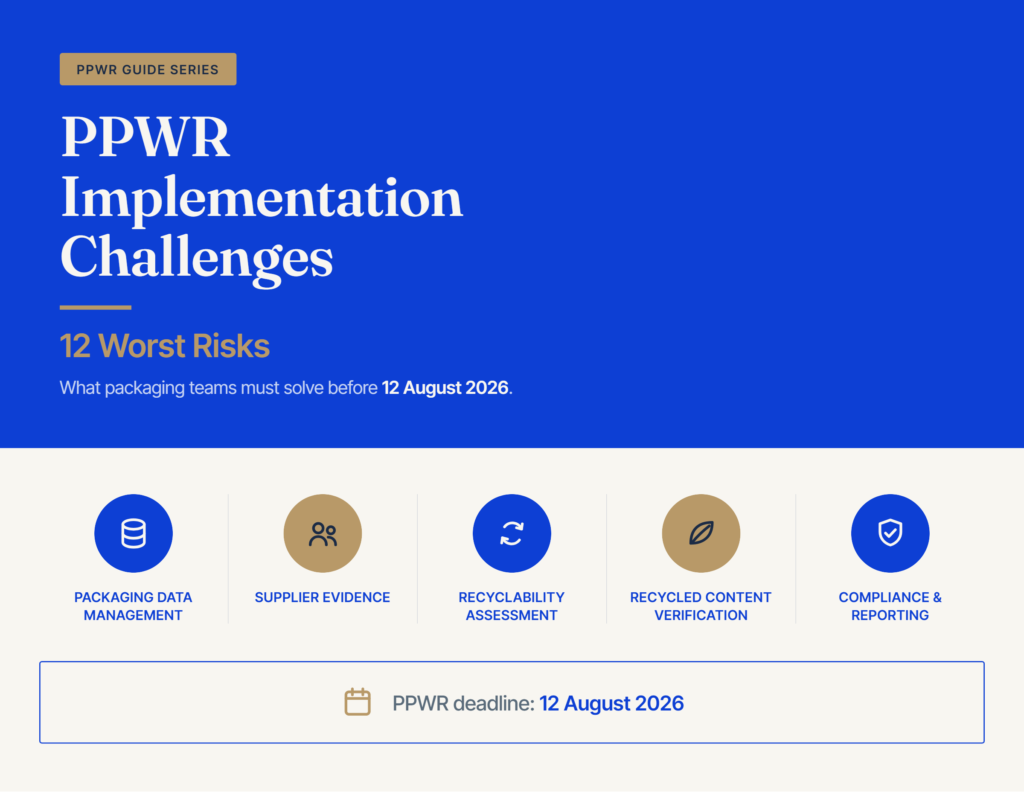
PPWR implementation challenges are becoming one of the biggest concerns for packaging teams preparing for the EU Packaging and Packaging Waste Regulation. The regulation is not only a sustainability regulation. It is a major operational shift that affects packaging design, packaging data, supplier evidence, recyclability, recycled content, substances of concern, PFAS, labelling, reuse, Extended Producer Responsibility and technical documentation.
These PPWR implementation challenges are not only regulatory issues; they are also data, supplier, documentation and internal coordination issues.
For packaging teams, PPWR implementation challenges must be managed as a structured readiness project rather than a last-minute compliance task.
PPWR entered into force on 11 February 2025 and will generally apply from 12 August 2026. The regulation covers all packaging and packaging waste, regardless of material or origin, and sets requirements for the manufacturing, composition, reusable nature and recoverable nature of packaging placed on the EU market. For official background, companies can refer to the European Commission’s page on packaging waste and the Packaging and Packaging Waste Regulation: https://environment.ec.europa.eu/topics/waste-and-recycling/packaging-waste_en
For packaging teams, this creates a major shift. In the past, many companies treated packaging compliance mainly as an EPR reporting exercise. They collected packaging weights, classified materials, submitted annual reports and paid producer responsibility fees in each relevant country. Under PPWR, that approach is no longer enough.
The new reality is more demanding. Packaging teams now need to prove that packaging is designed, documented and supported by reliable evidence before it is placed on the EU market. This means companies need structured data at SKU level, packaging unit level and component level. They also need supplier declarations, recyclability assessments, recycled content evidence, substances of concern checks, PFAS confirmations where relevant, labelling controls and technical documentation.
For many companies, the real difficulty is not simply understanding the regulation. The real difficulty is implementation. Packaging data is often scattered across ERP systems, PLM systems, Excel files, supplier PDFs, artwork folders, procurement records and local EPR reporting templates. Supplier evidence is often incomplete. Internal ownership is unclear. Technical files are not yet standardised. Packaging teams are therefore under pressure to move from fragmented information to a controlled, auditable and repeatable compliance system.
For this reason, PPWR implementation challenges should be addressed as early as possible, especially by companies with large SKU portfolios or complex supplier networks.
This article explains the 12 worst PPWR implementation risks for packaging teams, why these problems arise, how companies can solve them and what practical examples show about the work ahead.
Table of Contents
- Why PPWR Implementation Challenges Are Difficult for Packaging Teams
- Packaging Data Is Scattered Across Too Many Systems
- Supplier Evidence Is Slow, Incomplete and Difficult to Validate
- Recyclability Assessment Is Difficult Because the Full Methodology Is Still Evolving
- Recycled Content Evidence Is Difficult to Prove
- Substances of Concern and PFAS Checks Create New Evidence Pressure
- Technical Documentation and Declarations of Conformity Will Become a Major Workload
- Packaging Minimisation and Empty-Space Rules Require Redesign Decisions
- Reuse Systems Are Operationally Complex
- Labelling Changes Will Create Artwork and Market Coordination Problems
- EPR Data and PPWR Data Are Connected but Not the Same
- Legal Responsibility Is Not Always Obvious
- Internal Ownership Is Often Unclear
- What Should Packaging Teams Do First?
- Practical PPWR Data Model for Packaging Teams
- How RegSurance and PaxHub Can Support PPWR Readiness
- FAQs on PPWR Implementation Challenges
Why PPWR Implementation Challenges Are Difficult for Packaging Teams
PPWR changes the way companies need to manage packaging compliance. Compliance can no longer sit only at the end of the process, after packaging has already been designed, sourced and launched. Instead, PPWR requires companies to think about compliance much earlier, starting from material selection, packaging design, supplier onboarding, artwork planning and documentation control.
Most PPWR implementation challenges become difficult because packaging data is not available in one reliable, structured and evidence-backed format.
This is why companies should identify PPWR implementation challenges early and connect them with packaging design, supplier management and EPR reporting.
A simple example shows the issue. A company may already know that a product is sold in a PET bottle with a plastic cap and paper label. For traditional EPR reporting, the team may mainly need to know the total weight of plastic and paper placed on the market in each country. Under PPWR, that information is not enough. The company may also need to know the polymer type, bottle colour, cap material, label material, adhesive type, ink system, food-contact status, recycled content percentage, PFAS status, recyclability assessment result, supplier evidence and technical file reference.
This is why PPWR implementation should be treated as a packaging data and compliance transformation project. It requires coordination between packaging, procurement, regulatory, quality, sustainability, legal, finance, IT, artwork teams and local market teams.
1. Packaging Data Is Scattered Across Too Many Systems
One of the biggest PPWR implementation challenges is fragmented packaging data. In many companies, packaging information is not stored in one structured place. Some data sits in ERP. Some sits in PLM. Some is kept in Excel files. Some is buried in supplier specifications, PDF declarations, artwork files, quality folders or local reporting templates.
This creates a serious problem because PPWR requires reliable and detailed packaging information. Teams need to know what each packaging component is made of, how much it weighs, who supplied it, whether it is food-contact packaging, whether it contains recycled content, whether it is recyclable and whether evidence exists to support each claim.
For example, a food company may sell a ready-meal product in a tray with a film, sleeve and label. The EPR team may have reported the tray as plastic and the sleeve as paper for years. But PPWR readiness requires more detail. The packaging team needs to understand whether the tray is PET, PP or another polymer, whether the film affects recyclability, whether the sleeve adhesive is compatible, whether the materials are food-contact compliant and whether any recycled content claim is supported by evidence.
This is one of the most common PPWR implementation challenges because companies often have EPR-level data but not component-level compliance data.
The solution is to create a component-level packaging data model. Companies should structure packaging data around SKU, packaging unit and individual components. Each component should have a unique identifier, material type, material subtype, weight, supplier, food-contact status, recycled content status, recyclability status, substances status, evidence reference and market scope.
This does not mean every company must solve every SKU immediately. A practical approach is to start with high-risk packaging first. This usually includes plastic packaging, food-contact packaging, e-commerce packaging, multi-country SKUs, high-volume products, complex laminates, coated paper, barrier packaging and packaging with sustainability claims.
The objective is to move from scattered documents to a controlled packaging data backbone. Once the data backbone is in place, it can support EPR reporting, PPWR technical documentation, supplier evidence management, recyclability reviews and future regulatory updates.
2. Supplier Evidence Is Slow, Incomplete and Difficult to Validate
Supplier evidence is another major PPWR implementation challenge. Packaging teams depend on suppliers for material composition, coatings, inks, adhesives, recycled content, food-contact declarations, PFAS statements, heavy metal declarations, recyclability information and test reports.
The problem is that many suppliers are not yet ready to provide this information in a structured PPWR-ready format. Some suppliers send broad company-level declarations that do not clearly relate to the specific packaging component. Some provide outdated certificates. Some send incomplete PDFs. Some do not answer technical questions about coatings, adhesives or additives. Others respond only after multiple follow-ups.
For example, a cosmetics brand may ask a carton supplier whether a folding box is recyclable. The supplier may confirm that the carton is paperboard, but may not provide enough information about lamination, foil stamping, varnish, adhesive or ink. Without those details, the brand cannot properly assess the full packaging unit.
Supplier evidence is one of the most time-consuming PPWR implementation challenges because packaging teams cannot complete compliance assessments without reliable third-party information.
The solution is to replace ad hoc email requests with a structured supplier evidence process. Companies should create a standard PPWR supplier questionnaire that asks for component-specific information. The questionnaire should cover material composition, coatings, inks, adhesives, additives, food-contact status, PFAS status, heavy metals, recycled content, chain-of-custody evidence, recyclability information, declaration validity and change notification obligations.
Supplier evidence should also be linked to procurement. New supplier contracts and purchase terms should require suppliers to notify the company before any change in material composition, coating, adhesive, ink, recycled content source, food-contact status or manufacturing process. For high-risk packaging, companies should apply a simple rule: no evidence, no approval.
This is especially important for companies with large supplier bases. Without a structured supplier data process, packaging teams will spend months chasing documents and still end up with inconsistent evidence.
3. Recyclability Assessment Is Difficult Because the Full Methodology Is Still Evolving
Recyclability is one of the most important areas under PPWR, but it is also one of the most difficult to implement. PPWR states that all packaging placed on the market must be recyclable, and it introduces a system where packaging recyclability will be expressed through performance grades. From 2030, recyclability performance will be based on design-for-recycling criteria.
The difficulty is that recyclability is not determined only by the main material. It depends on the full packaging unit. Labels, closures, adhesives, colours, inks, sleeves, coatings and barrier layers can all affect sorting and recycling.
For example, a PET bottle may look recyclable because PET is widely recycled. But if the bottle has a full-body sleeve, dark colour or incompatible adhesive, the actual recyclability of the packaging unit may be affected. Similarly, a paper-based pack may appear recyclable, but a plastic coating or metallised layer may reduce its suitability for paper recycling.
This makes recyclability one of the most technical PPWR implementation challenges for packaging teams.
The solution is to assess recyclability at packaging unit level, not only material level. Packaging teams should create an interim recyclability assessment method that reviews the main material, all components, labels, sleeves, closures, adhesives, inks, coatings, barriers, colour, sorting behaviour and assumed recycling stream.
A good assessment should not simply say “recyclable” or “not recyclable”. It should explain the basis of the assessment. For example, the record could state that a PET bottle was assessed for the rigid PET recycling stream, that the cap and label were reviewed, that the adhesive compatibility is still under supplier confirmation and that a redesign option exists if future EU criteria require it.
Companies should also maintain a recyclability risk register. This register should identify packaging formats that may require redesign, such as multi-material laminates, full-body sleeves, black or dark plastics, metallised layers, incompatible adhesives and complex barrier structures.
4. Recycled Content Evidence Is Difficult to Prove
Recycled content is another important PPWR implementation challenge. The issue is not only whether a company can source recycled material. The issue is whether it can prove the recycled content in a way that is reliable, traceable and suitable for compliance or claims.
A supplier may state that a plastic bottle contains 30% recycled content. But the packaging team needs to know what that means. Is it post-consumer recycled content? Is it post-industrial recycled content? Is it physically present in the component? Is it based on a mass-balance method? Is the evidence batch-specific or based on annual allocation? Does it apply to the exact packaging component supplied? Is it suitable for food-contact packaging?
Among all PPWR implementation challenges, recycled content is especially sensitive because it affects both compliance and external sustainability claims.
These questions matter because recycled content claims can create regulatory, commercial and reputational risk if they are not properly supported.
The solution is to create a recycled content evidence register. This register should record the component, polymer type, recycled content percentage, supplier, evidence document, certificate validity, chain-of-custody model, food-contact status and review date.
Companies should also separate internal compliance data from external marketing claims. A company may use recycled content information internally for PPWR readiness, but any public claim should be reviewed carefully and supported by strong evidence.
For example, a packaging team may accept a supplier certificate for internal compliance tracking but still decide not to make a consumer-facing recycled content claim until legal and regulatory teams confirm that the evidence is strong enough.
5. Substances of Concern and PFAS Checks Create New Evidence Pressure
PPWR strengthens the focus on substances of concern in packaging. It requires packaging to be manufactured so that the presence and concentration of substances of concern are minimised. It also includes specific restrictions for PFAS in food-contact packaging.
For packaging teams, this is difficult because chemical information often sits deep in the supply chain. The relevant risk may not be in the main material alone. It may come from coatings, inks, adhesives, additives, recycled inputs, grease-resistant treatments, barriers or surface finishes.
For example, a paper-based food wrapper may appear simple, but if it has a grease-resistant coating, PFAS screening may become relevant. A fibre-based takeaway box may need more detailed supplier confirmation than a basic paperboard description. A label adhesive may also affect both substance assessment and recyclability.
Substances of concern and PFAS checks are PPWR implementation challenges that require close cooperation between packaging, suppliers, regulatory and quality teams.
The solution is to build substances screening into packaging development and supplier onboarding. Companies should create a component-level substances register covering substrates, coatings, inks, adhesives, barriers, additives and recycled inputs.
For food-contact packaging, suppliers should provide clear PFAS declarations. For higher-risk materials, supplier declarations may need to be supported by testing or additional technical evidence. Companies should prioritise food-contact packaging, grease-resistant packaging, coated papers, barrier materials, recycled-input packaging and complex laminates.
The key point is timing. Substance checks should happen before packaging launch, not after production, artwork approval or market placement.
6. Technical Documentation and Declarations of Conformity Will Become a Major Workload
PPWR brings packaging compliance closer to product compliance. Companies will need stronger technical documentation to show how packaging meets applicable requirements. This can include packaging descriptions, drawings, bills of materials, material specifications, supplier declarations, recyclability assessments, recycled content evidence, substances evidence, labelling information and declarations of conformity.
For companies with a small number of packaging formats, this may be manageable manually. For companies with hundreds or thousands of SKUs, manual documentation will quickly become inefficient and risky.
For example, a consumer goods company may have 2,000 active SKUs across multiple EU markets. If every SKU requires evidence, documentation and review, a manual Word-and-PDF approach will be difficult to maintain. Any supplier change, material change or artwork update could make the documentation outdated.
This is why technical documentation is one of the PPWR implementation challenges that companies should not leave until the final stage.
The solution is to create template-based technical documentation. Companies should group similar packaging formats into packaging families where appropriate. For example, a company may create separate documentation templates for PET bottles, folding cartons, flexible sachets, trays, jars, transport packaging and e-commerce packaging.
Each technical file should link back to structured data and supplier evidence. This allows companies to update documentation when materials, suppliers or regulations change. The goal is not only to create documents. The goal is to create a repeatable system that can be maintained over time.
7. Packaging Minimisation and Empty-Space Rules Require Redesign Decisions
PPWR also pushes companies to reduce unnecessary packaging weight and volume. This creates practical challenges because packaging serves many functions. It protects the product, supports logistics, carries mandatory information, provides tamper evidence, supports shelf display and helps communicate brand value.
For example, a luxury cosmetics brand may use large secondary packaging to create a premium unboxing experience. An e-commerce company may use oversized boxes because of warehouse limitations. A food company may use extra packaging to protect shelf life or prevent contamination. A pharma company may need secondary packaging for safety and information requirements.
Packaging minimisation is one of the PPWR implementation challenges that often creates internal debate, because compliance, brand presentation, product protection and logistics requirements may not always point in the same direction.
These PPWR implementation challenges are especially relevant for sectors where packaging also plays a strong branding, protection or consumer-experience role.
Under PPWR, companies will increasingly need to justify packaging based on functionality, not only marketing preference.
The solution is to introduce packaging minimisation reviews. Packaging teams should assess whether each packaging format is necessary for product protection, hygiene, safety, logistics, information requirements, tamper evidence or technical functionality. They should also review material weight, pack dimensions, empty space, transport efficiency and alternative designs.
For e-commerce, one of the fastest improvement areas is right-sized packaging. Companies can reduce oversized boxes, avoid unnecessary void fill, improve carton selection and use better packaging automation. This can reduce regulatory risk, material cost, transport cost and customer complaints about excessive packaging.
8. Reuse Systems Are Operationally Complex
Reusable packaging is not just a packaging format. It is an operating model. This is one of the most underestimated PPWR implementation challenges.
A reusable pack needs return logistics, tracking, cleaning, inspection, repair, customer participation, reverse transport, asset ownership and evidence of actual reuse. A pack that is durable is not automatically part of a functioning reuse system.
For example, reusable transport packaging may work well between a factory and a distribution centre because the route is controlled. The same model may be much harder in open consumer channels where return rates are uncertain and packaging may be lost.
The solution is to treat reuse as a supply chain project. Before scaling reusable packaging, companies should test the return model, cleaning process, hygiene control, loss rate, number of rotations, transport impact and cost per use. They should also define who owns the reusable packaging, who tracks it, who cleans it and what happens when it is damaged or lost.
A controlled pilot is usually the best starting point. Closed-loop B2B routes are often easier to test than open consumer systems. Tracking tools such as QR codes, RFID or digital asset IDs can help prove that packaging is actually reused and not only designed to be reusable.
9. Labelling Changes Will Create Artwork and Market Coordination Problems
PPWR aims to harmonise packaging labelling across the EU. In the long term, this should reduce fragmentation. In the short term, it creates a major artwork and transition challenge.
Many companies currently deal with country-specific sorting labels, Green Dot marks, deposit-return markings, multilingual artwork, recycling instructions and retailer-specific packaging requirements. Future PPWR labelling requirements will need careful planning so that artwork changes happen at the right time and in the right way.
For example, a consumer goods company selling the same SKU in France, Germany, Spain, Italy and the Netherlands may already have complex artwork requirements. Any future harmonised labelling requirement may affect artwork files, translations, printing plates, packaging stock, retailer approvals and market-specific inventory.
Labelling is one of the PPWR implementation challenges that can easily become a practical artwork and stock-management issue if companies do not plan the transition early.
The solution is to create a labelling and artwork transition roadmap. Companies should build an artwork inventory showing which SKUs are sold in which markets, which packaging components carry labels, which country-specific sorting labels are currently used, which packs are subject to deposit return systems and which artwork files are due for renewal.
Packaging and artwork teams should also reserve space for future mandatory information. This is particularly important for small packs, cosmetics, pharma, multilingual labels and packaging with limited printable area.
10. EPR Data and PPWR Data Are Connected but Not the Same
Many companies already report packaging data for Extended Producer Responsibility. However, EPR compliance and PPWR compliance are not the same.
EPR data usually focuses on placed-on-market quantities by country, material, weight and packaging category. PPWR requires deeper data on packaging design, recyclability, recycled content, substances, labelling, reuse, minimisation and technical documentation.
This means a company can be EPR-compliant today but still not PPWR-ready.
For example, a company may report 100 tonnes of plastic packaging in Germany for EPR purposes. But PPWR readiness requires knowing which SKUs and components make up that 100 tonnes, whether they are recyclable, whether recycled content applies, whether supplier evidence exists, whether PFAS is relevant and whether technical documentation is available.
EPR alignment is one of the PPWR implementation challenges because companies often need the same packaging data to serve different legal, financial and technical purposes.
The solution is to create one packaging data backbone with multiple outputs. The same structured data should support EPR reporting, PPWR technical compliance, supplier evidence management, recyclability assessments, recycled content tracking, labelling decisions and technical documentation.
This avoids duplication and reduces the risk that EPR reports, sustainability claims and PPWR documentation contradict each other.
11. Legal Responsibility Is Not Always Obvious
PPWR introduces and strengthens roles such as manufacturer, producer, importer, distributor and authorised representative. The challenge is that these legal roles do not always match internal business titles or commercial assumptions.
Responsibility may differ depending on whether the product is sold through a distributor, marketplace, direct-to-consumer channel, private label arrangement, co-packer, importer or EU subsidiary.
For example, a non-EU brand selling directly to EU consumers may have different obligations from an EU-based brand selling through distributors. A private label retailer may control the packaging design even if another company manufactures the product. A co-packer may physically fill the product, but the brand owner may control market placement and packaging specifications.
Legal responsibility is one of the PPWR implementation challenges that should be reviewed early, especially for companies with distributors, marketplaces, private label products or non-EU entities.
The solution is to create a legal responsibility decision tree. Companies should map who owns the brand, who controls the packaging design, who fills or packs the product, who imports into the EU, who first makes the packaged product available in each Member State, who sells to the end user, who is responsible for EPR registration and who signs the relevant technical documentation.
This mapping should be done by route to market. Direct-to-consumer, retail, distributor, marketplace, private label and B2B routes may produce different responsibility outcomes.
12. Internal Ownership Is Often Unclear
PPWR sits across many departments. Packaging owns design and specifications. Procurement owns supplier relationships. Regulatory owns interpretation. Quality owns documentation control. Sustainability owns targets and claims. Legal owns responsibility and risk. Finance owns EPR fees. IT owns systems and data. Marketing owns artwork and claims. Supply chain owns logistics and reuse.
This creates implementation problems because no single team naturally owns the full process.
For example, packaging may redesign a pack, procurement may change a supplier, marketing may update artwork and finance may report EPR data. But if no one checks whether the PPWR technical file has been updated, the company may create a compliance gap.
Internal ownership is one of the PPWR implementation challenges that determines whether the company moves from discussion to actual execution.
The solution is to treat PPWR as a cross-functional programme. Companies should appoint one PPWR programme owner with authority to coordinate packaging, procurement, regulatory, quality, legal, finance, IT, sustainability, artwork and local markets.
There should be clear workstreams for packaging data, supplier evidence, technical documentation, recyclability, recycled content, labelling, EPR reporting and legal responsibility. For high-risk packaging, companies should also introduce launch gates. A packaging format should not move to commercial launch unless required evidence is available or a documented risk decision has been approved.
Once these PPWR implementation challenges are mapped clearly, companies can prioritise high-risk packaging formats instead of trying to fix the entire portfolio at once.
What Should Packaging Teams Do First?
The most practical first step is to create a PPWR readiness baseline.
This baseline helps companies turn broad PPWR implementation challenges into clear actions, owners and deadlines.
A PPWR readiness baseline means building a clear picture of where the company stands today before starting detailed implementation work.
A good readiness baseline should help the packaging team answer five core questions.
First, the company should identify which packaging formats are placed on the EU market. This includes primary packaging, secondary packaging, transport packaging, e-commerce packaging, reusable packaging and any country-specific packaging variations.
Second, the team should determine which SKUs and packaging components carry the highest compliance risk. High-risk areas usually include plastic packaging, food-contact packaging, complex laminates, coated paper, packaging with recycled content claims, packaging with PFAS risk and high-volume products sold across multiple EU markets.
Third, the company should assess what packaging data is already available. This includes material types, component weights, supplier details, packaging specifications, artwork files, EPR reporting data, food-contact declarations and existing recyclability information.
Fourth, the team should identify what supplier evidence is missing. This may include recycled content certificates, PFAS declarations, heavy metal declarations, food-contact documents, coating details, adhesive information, substances of concern confirmations and recyclability evidence.
Finally, the company should decide which packaging formats require action. Some packaging may need redesign, some may need additional technical documentation, and some may require legal clarification around producer responsibility, importer status, authorised representative requirements or market placement.
Once this baseline is complete, packaging teams can prioritise work properly instead of trying to fix the entire portfolio at once. It also gives management a clear view of the resources, timelines and budget needed for PPWR implementation.
Practical PPWR Data Model for Packaging Teams
A practical PPWR data model should not look like a simple checklist. It should be structured in a way that helps packaging, regulatory, procurement, sustainability and EPR teams use the same data for different compliance needs.
The first layer should identify the product and the packaging format clearly. This includes the SKU or GTIN, product name, packaging family, packaging unit ID and component ID. For example, one product may have a primary bottle, cap, label, secondary carton and transport box. Each of these components should be separately identifiable, because each may have a different material, supplier, weight and compliance risk.
The second layer should capture the technical details of each packaging component. This includes the component material, material subtype, component weight, supplier, food-contact status and market scope. This helps the company understand exactly what packaging is being placed on the EU market and where it is being sold.
The third layer should record the PPWR-relevant compliance attributes. This includes recycled content percentage, recycled content evidence, PFAS and substances of concern status, recyclability assessment result, reuse status and packaging minimisation information where relevant. This layer is critical because it connects packaging design with PPWR compliance.
The fourth layer should connect PPWR data with country-level EPR reporting. This includes the EPR material category, packaging type, household or commercial packaging classification, country of placement and reporting responsibility. This ensures that the same packaging data can support both PPWR readiness and EPR declarations.
The final layer should link the packaging data to supporting documents and version control. This includes artwork version, supplier declaration reference, technical file reference, declaration of conformity reference, evidence validity date and review date. This helps companies demonstrate that the data is not only collected, but also supported by documentation and kept up to date.
A well-structured PPWR data model allows packaging teams to move away from scattered spreadsheets and supplier PDFs. It creates one controlled source of truth that can support recyclability assessments, recycled content tracking, substances checks, EPR reporting, labelling decisions and technical documentation.
In short, PPWR implementation challenges should be treated as a structured readiness programme, not as a one-time regulatory checklist.
How RegSurance and PaxHub Can Support PPWR Readiness
PPWR implementation requires both regulatory understanding and strong packaging data management. Companies need to know what the rules require, but they also need a practical system to collect, structure, validate and maintain the data behind compliance.
RegSurance supports companies with PPWR and packaging EPR readiness, including regulatory scoping, producer responsibility assessment, supplier data collection, packaging data gap analysis, recyclability and documentation readiness, country-specific EPR support and technical documentation preparation.
PaxHub is our packaging data platform built to help companies bring packaging data from ERP, PLM, Excel files, PDFs and supplier specifications into one structured place, mapped to PPWR and EPR requirements. PaxHub supports packaging data consolidation and controlled distribution of SKU-level packaging data and evidence across internal teams and external stakeholders, reducing manual back-and-forth.
For companies preparing for PPWR, the key question is no longer only whether they understand the regulation. The real question is whether they can prove, at SKU and component level, that their packaging is ready.
Learn more: https://regsurance.com/paxhub-packaging-data-platform-for-ppwr-and-epr/
The full legal text of Regulation (EU) 2025/40 is available on EUR-Lex: https://eur-lex.europa.eu/eli/reg/2025/40/oj/eng
Conclusion
PPWR implementation is not a last-minute reporting exercise. It is a packaging data, supplier evidence, design control and documentation challenge.
The companies that struggle will be the ones that wait until the deadline before cleaning their packaging data. The companies that succeed will be the ones that start early, build a structured packaging data backbone, engage suppliers, clarify internal responsibility and connect PPWR compliance with EPR reporting, packaging design, procurement, artwork and technical documentation.
The companies that address PPWR implementation challenges early will be better prepared to manage packaging data, supplier evidence, EPR reporting and technical documentation at scale.
In practical terms, solving PPWR implementation challenges means building a repeatable system for data, evidence, documentation and internal governance.
Packaging teams should start with a simple but important question: can we prove compliance for every relevant packaging component, SKU and market?
If the answer is not yet clear, now is the time to build the system.
FAQs on PPWR Implementation Challenges
1. What are the main PPWR implementation challenges for packaging teams?
The main PPWR implementation challenges include scattered packaging data, incomplete supplier evidence, recyclability assessment uncertainty, recycled content proof, PFAS and substances checks, technical documentation, labelling changes, EPR alignment and unclear internal ownership.
2. Why is packaging data important for PPWR compliance?
Packaging data is important because PPWR requires companies to understand packaging at SKU, packaging unit and component level. Without structured data, companies cannot properly assess recyclability, recycled content, substances of concern, labelling, minimisation or technical documentation.
3. Is EPR data enough for PPWR compliance?
No. EPR data is useful, but it is not enough for PPWR compliance. EPR reporting usually focuses on packaging weight, material and country placement. PPWR requires deeper evidence on design, recyclability, recycled content, substances, labelling, reuse and technical documentation.
4. Why is supplier evidence important under PPWR?
Supplier evidence is important because many compliance details sit with suppliers. Packaging teams need supplier information on material composition, coatings, inks, adhesives, recycled content, PFAS, food-contact status, recyclability and substance declarations.
5. How should companies start preparing for PPWR?
Companies should start with a PPWR readiness baseline. They should map packaging placed on the EU market, identify high-risk SKUs, assess existing data, identify missing supplier evidence and prioritise packaging that may require redesign or documentation.
6. Which packaging formats should be prioritised first?
Companies should prioritise food-contact packaging, plastic packaging, high-volume SKUs, e-commerce packaging, multi-country packaging, complex laminates, coated paper, barrier materials, reusable packaging and packaging with sustainability claims.
7. What is a PPWR technical file?
A PPWR technical file is a structured evidence file that supports packaging compliance. It may include packaging descriptions, drawings, bills of materials, supplier declarations, recyclability assessments, recycled content evidence, substances evidence, labelling information and conformity records.
8. Why is recyclability assessment difficult under PPWR?
Recyclability assessment is difficult because it depends on the full packaging unit, not only the main material. Labels, adhesives, inks, coatings, closures, sleeves, colours and barriers can all affect sorting and recycling.
9. How can PaxHub help with PPWR implementation?
PaxHub helps companies structure packaging data from ERP, PLM, Excel, PDFs and supplier specifications into one controlled system mapped to PPWR and EPR requirements. It supports data consolidation, evidence tracking, gap identification and controlled data distribution.
10. When should companies start PPWR preparation?
Companies should start immediately. PPWR generally applies from 12 August 2026, and many companies will need significant time to collect supplier evidence, clean packaging data, assess recyclability, prepare technical documentation and align internal ownership.
Disclaimer
This article is for general information only and should not be treated as legal advice. PPWR obligations should be assessed based on each company’s specific products, packaging formats, legal entities, supply chains, sales channels and EU markets.